Comparison of Advantages: King‑brand Ventilation Fan (Variable‑Diameter, 5 Blades) vs. Standard Brand (Constant‑Diameter, 6 Blades)
Aerodynamics and Air Supply Efficiency
• King Ventilation – Variable-Section, 5 Blades
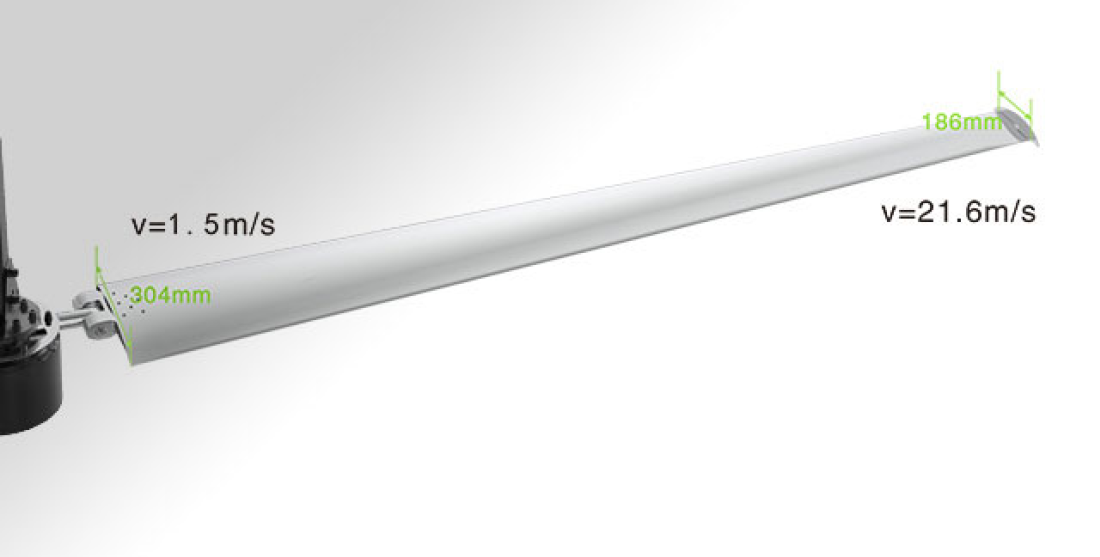
◦ Designed according to the equal chord‑length principle: root width 304 mm → tip width 186 mm; thickness 43 mm → 21 mm, with an airfoil‑like streamlined profile.
◦ Conical airflow diffusion with no voids in the center, covering an area of 2,000 m² or more; air volume: 15,072–16,870 m³/min.
◦ Low wind resistance and high aerodynamic efficiency, resulting in greater energy savings at the same airflow rate.
• Standard, constant‑section, 6‑blade
◦ The blades are of uniform width and thickness, resulting in a high drag coefficient; the airflow is cylindrical, with a distinct central void.
◦ Six-blade designs offer denser cutting, but increased drag reduces efficiency; at the same power level, they deliver lower airflow and poorer coverage.
2. Energy Consumption and Motor Load
• King’s Ventilation
◦ 5 Blades are lighter: total weight approximately 38.5 kg (7.3 m), with low motor load.
◦ Variable cross-section + inward shift of the center of gravity, resulting in minimal torque loss; when paired with a PMSM permanent‑magnet motor, it achieves approximately 30% energy savings, consuming no more than 1.2 kWh per hour.
• Ordinary 6 leaves
◦ With more blades and greater weight, the motor experiences a higher load and consumes more electricity.
◦ A constant‑cross‑section design results in higher aerodynamic drag, requiring greater torque, higher energy consumption, and a shorter motor lifespan.
3. Mute and Vibration Control • King’s Ventilation
◦ Odd-numbered 5‑leaf design: asymmetrical about the axis, less prone to resonance, and offers more stable dynamic balancing.
◦ Variable cross-section + aerospace-grade 5052 aluminum alloy, with ultra-low noise of 39 dB, avoiding the frequency range to which the human ear is most sensitive. • Ordinary 6 leaves
◦ Even-numbered 6-blade: prone to resonance, significant vibration, and high noise levels.
◦ A constant‑cross‑section eddy current generates strong high‑frequency noise, resulting in increased loudness and reduced comfort.
4. Structural Safety and Service Life
• King’s Ventilation
◦ The leaf base is thickened and reinforced, with the center of gravity shifted inward, resulting in reduced centrifugal force and improved resistance to breakage.
◦ Secured with 16 rivets and lockbolts, each leaf can withstand a tensile force of 1.7 tons, ensuring high safety redundancy.
◦ Low vibration, reduced fatigue, longer service life, and less maintenance.
• Ordinary 6 leaves
◦ Non-uniform stress distribution along the blade cross-section leads to stress concentration at the blade root, making it prone to cracking over time.
◦ Even-numbered resonances + greater inertia result in a higher risk of fracture.
5. Wind Sensation and Comfort Level
• King’s Ventilation
◦ Simulates natural winds of levels 2–3, gentle and not harsh, delivering a perceived temperature drop of 5–8°C.
◦ Uniform air distribution throughout the entire space, with no dead zones; long-term use remains comfortable and does not cause fatigue.
• Ordinary 6 leaves
◦ The wind sensation is relatively “hard,” with a strong pulsating quality; in the central void zone, there is either no wind or only weak wind.
◦ Prolonged blowing can easily cause discomfort, and the improvement in temperature stratification is limited.
Key Conclusions
The King ventilation fan with a variable‑diameter design and 5 blades outperforms conventional constant‑diameter 6‑blade models across all four key metrics—energy efficiency, quiet operation, safety, and airflow uniformity.
• ✅ Over 30% energy savings, lower noise, longer lifespan, and wider coverage
• ✅ 5 blades + variable blade pitch is the golden combination for HVLS industrial fans
Tags: